



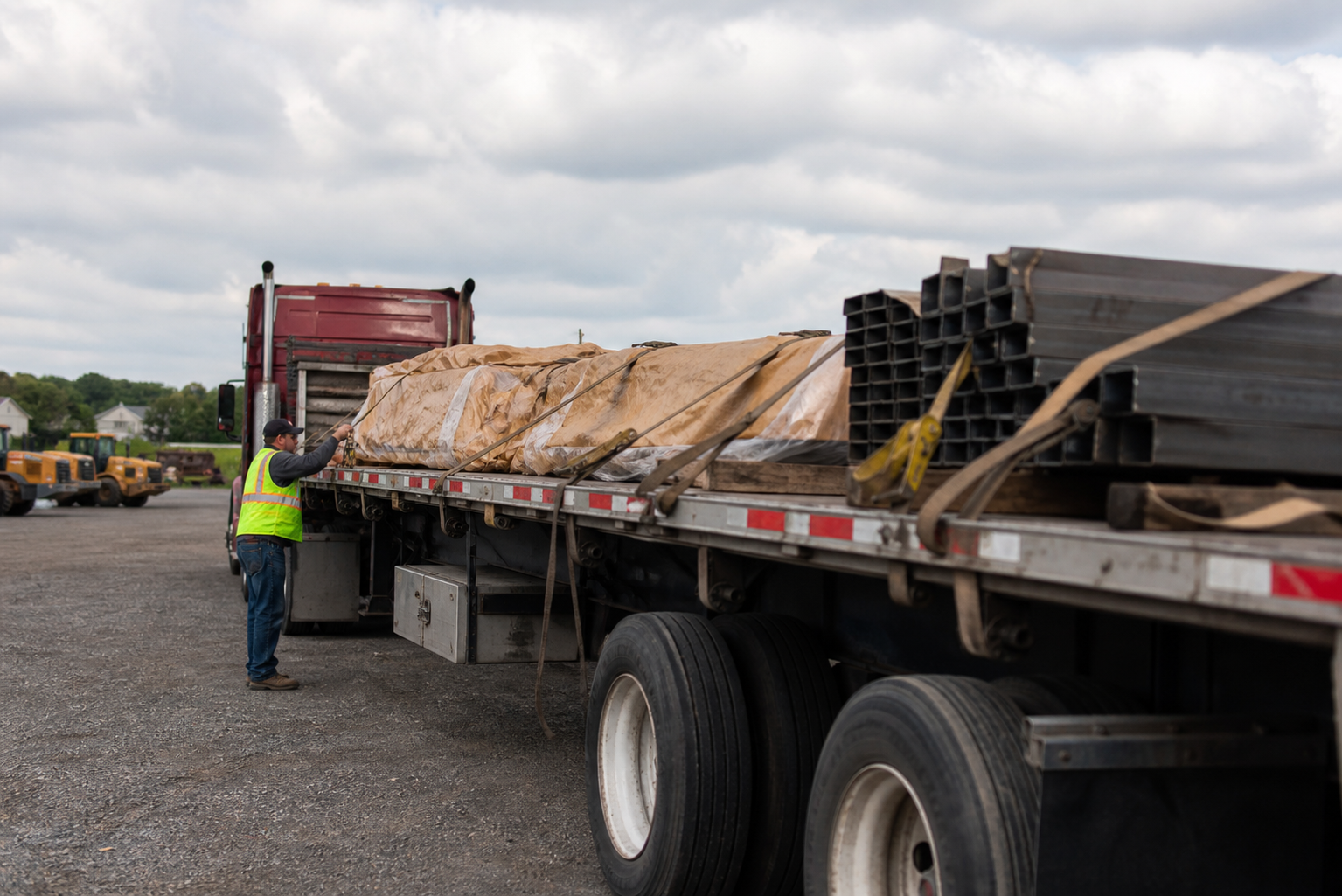
If you have recently tried booking a flatbed load, you have probably noticed one thing – the pricing does not make sense anymore. A lane that cost you $3 per mile last year is suddenly being quoted at $8, $10, or even higher. Carriers are throwing out numbers that feel random, and finding a reliable truck at a reasonable rate has become frustratingly difficult.
Flatbed shipping rates in the USA are not just rising – they are becoming harder to predict. Traditional pricing benchmarks that shippers relied on for years no longer hold up the way they used to. What worked as a budgeting strategy in 2022 or 2023 can leave you seriously underprepared today.
At S&S Brokerage Inc., we are seeing this shift play out across lanes every day. For many shippers in construction, steel, lumber, and heavy equipment, it is becoming harder to tell what is a fair rate versus what is simply market chaos.
So what is actually going on in the flatbed market right now? And more importantly, how do you avoid overpaying while still getting your freight moved on time? In this guide, we break down exactly why flatbed shipping rates in the USA are so volatile right now – and how smart shippers are adapting to reduce costs, secure capacity, and work with the right partners.
What Is Flatbed Shipping and Who Needs It?
Flatbed shipping uses open-deck trailers without walls or a roof. This makes them the go-to option for freight that cannot fit inside a standard dry van – think steel coils, lumber bundles, construction machinery, pipe, precast concrete, and oversized industrial equipment.
Unlike dry van or refrigerated freight, flatbed loads typically require additional handling. Drivers are responsible for securing the load with straps, chains, and binders, and in many cases they must tarp the freight to protect it from weather. That extra labor is built into the rate – and it is one reason flatbed pricing works differently than other freight modes.
Industries that depend heavily on flatbed transportation include:
- Construction companies moving building materials and equipment to job sites
- Steel and metal distributors shipping coils, beams, and plate
- Lumber yards and building supply companies
- Machinery dealers and heavy equipment operators
- Agricultural equipment manufacturers and distributors
For these businesses, flatbed capacity is not optional. When rates spike or trucks go unavailable, entire project timelines can stall.
Why Flatbed Shipping Rates in the USA Are So High Right Now
This is the question every shipper in the flatbed space is asking. The answer is not a single factor – it is a combination of pressures that have stacked up over the past few years and show no signs of fully reversing.
Operating Costs Have Increased Significantly
Every flatbed carrier is running a business, and the cost of running that business has gone up across every line item. Fuel remains volatile. Insurance premiums for commercial trucking have increased sharply over the past several years. The cost of purchasing and maintaining flatbed equipment – trailers, tarps, tie-down hardware – has risen with inflation. And driver wages have had to go up as carriers compete to attract and retain qualified drivers.
All of these costs get passed through to shippers in the form of higher per-mile rates. There is no way around it. When a carrier’s break-even point rises, their minimum acceptable rate rises with it.
Flatbed Involves More Work Than Dry Van
A dry van driver backs into a dock, freight gets loaded by warehouse workers, and the doors close. A flatbed driver often has to assist with loading, position and secure every strap and chain themselves, apply tarps if required, and then re-secure the load at inspection points along the route.
That additional labor time is real. On a complex load – a piece of heavy machinery with irregular dimensions, or a full load of steel coils – a driver can spend two to three hours just on the securing and tarping process before the truck moves an inch. That time has value, and carriers price accordingly.
Flatbed Capacity Is Genuinely Tight
This is arguably the most important factor driving current flatbed shipping rates in the USA. There are simply fewer available flatbed trucks than there are loads that need to move.
Several dynamics are contributing to this. Some carriers who survived difficult freight cycles in recent years have scaled back their fleets or exited the market entirely. New regulations around hours of service, electronic logging, and emissions have added operational friction. And because flatbed requires a more skilled driver – one who knows load securement, tarping technique, and oversized permit requirements – the driver pool is narrower than in other freight modes.
When demand holds steady and supply shrinks, carriers gain pricing power. That is exactly the situation the market is in right now.
Short Haul Flatbed Rates Are Especially Painful
Short haul lanes – moves under 300 to 400 miles – are often where shippers experience the biggest sticker shock. A short run of 200 miles might be quoted at $1,500 or more, which translates to a per-mile rate that feels extreme compared to longer hauls.
The reason is simple economics. A driver picking up a 200-mile load still has to drive to the pickup location, load and secure the freight, complete the delivery, and then find a reload heading back to their home area. If there is no return freight available on that lane, the carrier is absorbing deadhead miles. The short haul rate has to cover all of that exposure.
Lane Imbalances and Deadhead Miles
Deadhead miles – miles driven with an empty trailer – are a cost that carriers must recover somewhere. On lanes where freight predominantly moves in one direction, carriers heading back empty will either decline the outbound load or price it high enough to offset the return trip.
Construction-heavy markets, for example, often see freight flowing into a region during a building boom but with very little freight moving out. Carriers know this, and their rates on inbound loads reflect the deadhead exposure on the outbound leg.
Carriers Are Recovering Lost Margin
The flatbed market went through extended periods of compressed margins in prior years. Carriers who stuck it out are now pricing with recovery in mind. They are not just covering today’s costs – they are building back margin that was eroded during softer cycles. That is a rational business decision, but it means shippers are absorbing that recovery in their current rates.
What This Means for Your Business
For shippers in construction, steel, and heavy equipment, the impact of elevated flatbed shipping rates goes beyond the freight invoice. When rates are unpredictable, budgeting becomes harder. Project cost estimates that include freight as a line item can be off by thousands of dollars if rates spike between the estimate and the actual shipment.
Delays caused by capacity shortages can push back project timelines, affect contractor schedules, and in some cases trigger penalty clauses in construction contracts. A steel fabricator waiting on a delivery of structural beam that does not arrive on time does not just lose the freight day – they lose a day of production.
For Amazon sellers and e-commerce businesses moving oversize goods, unpredictable flatbed rates add a layer of cost variability that is hard to absorb when margins are already tight.
The shippers who are managing this environment best are the ones who stopped treating flatbed freight as a spot market commodity and started treating it as a relationship-based service that requires planning.
Common Problems Shippers Face with Flatbed Rates – and How to Solve Them
Problem 1: Relying on Spot Rates for Every Load
Spot market rates are the highest rates you will pay in a carrier-favored market. When you call for a truck with 24 hours notice on a popular lane during a busy week, you are at the mercy of whatever capacity is available – and whoever is available knows it.
Solution: Where your freight volume allows, work toward contract or dedicated arrangements with carriers or brokers. Even informal agreements to offer consistent volume in exchange for priority service and more stable rates can make a significant difference.
Problem 2: Shopping Rates Across Too Many Brokers
A lot of shippers think that getting quotes from five different brokers guarantees the best price. In practice, many of those brokers are calling the same carriers. The difference is not always the rate – it is which broker has a real relationship with that carrier and which one is just cold-calling.
Solution: Consolidate your flatbed volume with a broker who knows your freight and your lanes. Carriers prioritize partners they have a track record with, and that translates to better availability and more honest pricing.
Problem 3: Not Accounting for Accessorial Costs
Shippers sometimes focus entirely on the per-mile rate and overlook the accessorial charges that stack on top. Tarping fees, extra stop charges, detention fees when trucks wait beyond free time, and oversize permitting costs can add hundreds of dollars to a load that looked reasonably priced on paper.
Solution: Ask your broker or carrier to quote all-in, including any expected accessorials for your specific freight and lane. A $4 per mile quote with $400 in extras is not the same as a $4.50 per mile quote with nothing additional.
Problem 4: Booking with Price-Only in Mind
Choosing the cheapest available carrier on a flatbed load carries real risk. Flatbed requires a driver who knows load securement and tarping. A carrier with poor safety ratings or a history of cargo claims is not a bargain – they are a liability.
Solution: Evaluate carriers on safety ratings, equipment condition, and communication standards alongside price. Your freight, your schedule, and your customer relationships are worth more than saving $150 on the line haul.
Real-World Scenario: How One Construction Supplier Adapted
A building materials supplier in the mid-Atlantic region was moving regular loads of lumber and structural steel to construction sites across a three-state area. They had been booking spot market trucks on a load-by-load basis and started seeing rates climb steeply – some short haul quotes came in at nearly double what they had paid the year before.
After connecting with S&S Brokerage Inc., they shifted to a lane-by-lane planning approach. Instead of calling for trucks the day before pickup, they began sharing weekly freight calendars two to three weeks out. S&S used that visibility to line up preferred carriers in advance and negotiate better positioning on lanes where return freight was available.
The result was not a dramatic rate reduction – the market is what it is – but the supplier regained predictability. Their rates stabilized within a range they could budget around, and their on-time delivery rate improved because they were no longer scrambling for last-minute capacity.
That kind of proactive coordination is exactly what separates reactive freight management from strategic shipping.
Flatbed Freight Cost per Mile in 2026: What to Expect
Flatbed freight cost per mile in 2026 varies significantly based on lane, region, distance, and freight type. That said, here are general ranges shippers are encountering in the current market:
| Lane Type | Estimated Rate Range per Mile |
| Short haul (under 300 miles) | $5.00 to $12.00+ |
| Medium haul (300 to 1,000 miles) | $3.50 to $6.50 |
| Long haul (1,000+ miles) | $2.50 to $4.50 |
| Oversized or permitted loads | Add $1.00 to $3.00+ per mile |
| Tarping required | Add $100 to $300 per load |
These are market estimates for standard flatbed freight under current conditions. Actual rates depend on your specific lane, freight type, urgency, and carrier availability. Rates on tight lanes or during peak construction season will run toward the higher end of these ranges.
Why Work with a Flatbed Freight Broker vs. Going Direct to Carriers
Some shippers prefer to call carriers directly, believing it cuts out the broker margin and saves money. In a well-balanced market with easy capacity, that logic sometimes holds. In today’s flatbed market, it usually does not.
A freight broker with active carrier relationships can access capacity that is not publicly available. Carriers prioritize partners who send them consistent freight, and brokers who do volume across multiple clients carry more leverage than a single shipper calling once a month. The broker’s margin is often offset by better rate access and saved time.
Beyond rate access, a good broker manages the coordination – tracking the truck, communicating delays, handling documentation, and stepping in when something goes wrong on the road. That operational support has real value for shippers who are running lean teams.
Why S&S Brokerage Inc. for Flatbed Freight
S&S Brokerage Inc. has been moving flatbed freight across the United States for over two decades. With operations across 48 states and a carrier network built on consistency and performance, the company brings genuine market knowledge to every load.
What S&S brings to flatbed shippers specifically is a combination of carrier relationships and real-time communication. When capacity gets tight on a lane, S&S works its network to find options before the pickup window closes. When rates spike on a specific corridor, the team is transparent about what the market looks like and what options are available.
For shippers in construction, steel, machinery, and lumber – industries where freight delays have downstream consequences – that kind of reliable execution matters more than a low quote that falls through at the last minute.
S&S Brokerage is not the right fit for every shipper. But if you are moving flatbed freight regularly and you are tired of unpredictable rates and last-minute scrambles, we are worth a conversation.
Actionable Tips to Manage Flatbed Shipping Costs in 2026
These are practical steps you can take now to get more control over your flatbed freight spend.
- Plan further out. Even two to three weeks of visibility into upcoming loads gives brokers and carriers time to position trucks and quote more competitive rates. Last-minute freight almost always costs more.
- Share volume commitments where you can. Carriers value predictability. If you can offer a carrier consistent lanes over a month or a quarter, you are a more attractive shipper – and that often translates to better rates and availability.
- Be flexible on pickup day and time. A pickup that shifts from Friday afternoon to Monday morning can save real money and improve your transit performance. Even modest scheduling flexibility opens up better carrier options.
- Ask about fuel surcharge terms upfront. Fuel surcharges on flatbed freight are typically calculated as a percentage of the linehaul rate and fluctuate with diesel prices. Knowing how this is calculated helps you compare quotes on a true apples-to-apples basis.
- Build relationships with two or three brokers you trust. Having redundant broker relationships means you have options when your primary contact cannot cover a load. But keep the list short – spreading volume too thin reduces your leverage with everyone.
Know your accessorials before you ship. Tarping requirements, permits for oversized loads, and detention policies should be confirmed before the truck is booked, not after it arrives.
Conclusion
Flatbed shipping rates in the USA are high right now, and the volatility is not going away quickly. Fuel costs, tight capacity, driver wages, and lane imbalances have all stacked up to create a market where shippers who rely on old pricing assumptions are consistently getting surprised.
The good news is that smart planning, better carrier relationships, and working with experienced freight brokers can take a significant amount of that unpredictability off the table. You may not be able to control market rates – but you can control how well-positioned you are to navigate them.
S&S Brokerage Inc. has the carrier relationships, market knowledge, and operational support to help your business move flatbed freight reliably in today’s environment.
Frequently Asked Questions
Q1: Why are flatbed shipping rates so high in the USA right now? A: Flatbed rates are elevated due to a combination of factors: rising carrier operating costs including fuel, insurance, and wages; tight capacity from reduced fleet sizes and a smaller pool of qualified flatbed drivers; and a market cycle that currently favors carriers. Short haul lanes and urgent loads are experiencing the sharpest rate increases.
Q2: What is the average flatbed freight cost per mile in 2026?
A: In 2026, flatbed freight cost per mile typically ranges from $2.50 to $6.50 for standard loads depending on distance and lane. Short haul moves under 300 miles can run $5 to $12 per mile or more due to deadhead exposure and setup costs. Oversized or permitted loads add additional cost on top of the base rate.
Q3: Why are short haul flatbed rates higher per mile than long haul?
A: Short haul loads cover less distance but still require the same pickup, load securement, and delivery effort. Carriers also face more deadhead miles proportionally on short hauls, especially on lanes where return freight is limited. The fixed costs of operating the truck get spread over fewer miles, resulting in a higher per-mile rate.
Q4: Should I use a flatbed freight broker or go direct to carriers?
A: In a tight capacity market, a broker with established carrier relationships typically provides better access to available trucks and more competitive rates than cold-calling carriers directly. Brokers also manage coordination and communication throughout the load. Going direct to carriers makes more sense if you have an existing relationship with a specific carrier who services your lanes regularly.
Q5: How can I reduce my flatbed shipping costs?
A: The most effective strategies are booking further in advance, offering consistent volume to earn carrier loyalty, being flexible on pickup timing, and consolidating your freight with a broker who knows your lanes. Avoiding spot market bookings whenever possible and confirming all accessorial charges upfront also helps control total freight spend.
Q6: What industries use flatbed shipping the most?
A: The primary users of flatbed transportation are construction companies, steel and metal distributors, lumber and building material suppliers, heavy equipment dealers, and agricultural equipment manufacturers. Any industry moving freight that is too large, heavy, or irregularly shaped for a standard dry van trailer depends on flatbed capacity.
Q7: How do I find a reliable flatbed carrier or broker in the USA?
A: Look for brokers or carriers with a verifiable track record on your specific lanes, strong safety ratings on FMCSA’s SAFER database, and a communication process that keeps you informed throughout the load. Volume consistency and relationship quality matter more in flatbed than in most other freight modes, so it is worth investing time in finding a partner who understands your freight.
Another essential reason to modify to solar energy may be the cost savings it offers. Solar energy panels can handle generating electricity for businesses, reducing or eliminating the necessity for traditional types of energy. This will lead to significant savings on energy bills, particularly in areas with high energy costs. Furthermore, there are many different government incentives and tax credits open to companies that adopt solar technology, rendering it a lot more cost-effective and affordable.
The technology behind solar technology is simple and easy, yet highly effective. Solar panels are made up of photovoltaic (PV) cells, which convert sunlight into electricity. This electricity may then be kept in batteries or fed directly into the electrical grid, with regards to the specific system design. So that you can maximize some great benefits of solar technology, it’s important to design a custom system that is tailored to your unique energy needs and requirements. This can make certain you have the proper components in position, like the appropriate amount of solar energy panels as well as the right style of batteries, to optimize your time efficiency and cost savings.
Becoming part of the international sustainable community alongside Matthew D’Agati.
Solar Panel Recycling and Waste Management 822f73_